Case study
Automated Accounts Payable Invoice Processing
Turning repetitive invoice review into an exception-based workflow.
DisclosureSupplier names, account codes, invoice values, approval limits, file names, and identifiers shown in the supporting visuals are fictionalized to demonstrate the implemented workflow without exposing confidential business information.
The problem
Accounts-payable invoice processing often looks simple from the outside. In practice, it can involve repetitive document review, supplier-specific rules, accounting allocation, tax treatment, approval thresholds, and constant exceptions.
I designed and built an automated invoice-processing workflow to handle the predictable work while keeping uncertain cases in human hands.
Recurring transportation and operating invoices required manual review to identify the supplier, capture invoice numbers, dates, and totals, separate tax and fuel surcharges, determine accounting allocation, check approval criteria, identify missing or unusual information, and retain supporting records for audit purposes.
Different suppliers used different invoice formats, and those formats could change over time. A reliable solution therefore needed to automate routine decisions without assuming every invoice would fit a perfect template.
Understanding the problem
One of the most important design decisions was separating three types of logic:
- Document parsing
- How information is located on a particular supplier's invoice.
- Accounting rules
- How that supplier's charges should be allocated.
- Approval rules
- What conditions allow an invoice to proceed automatically.
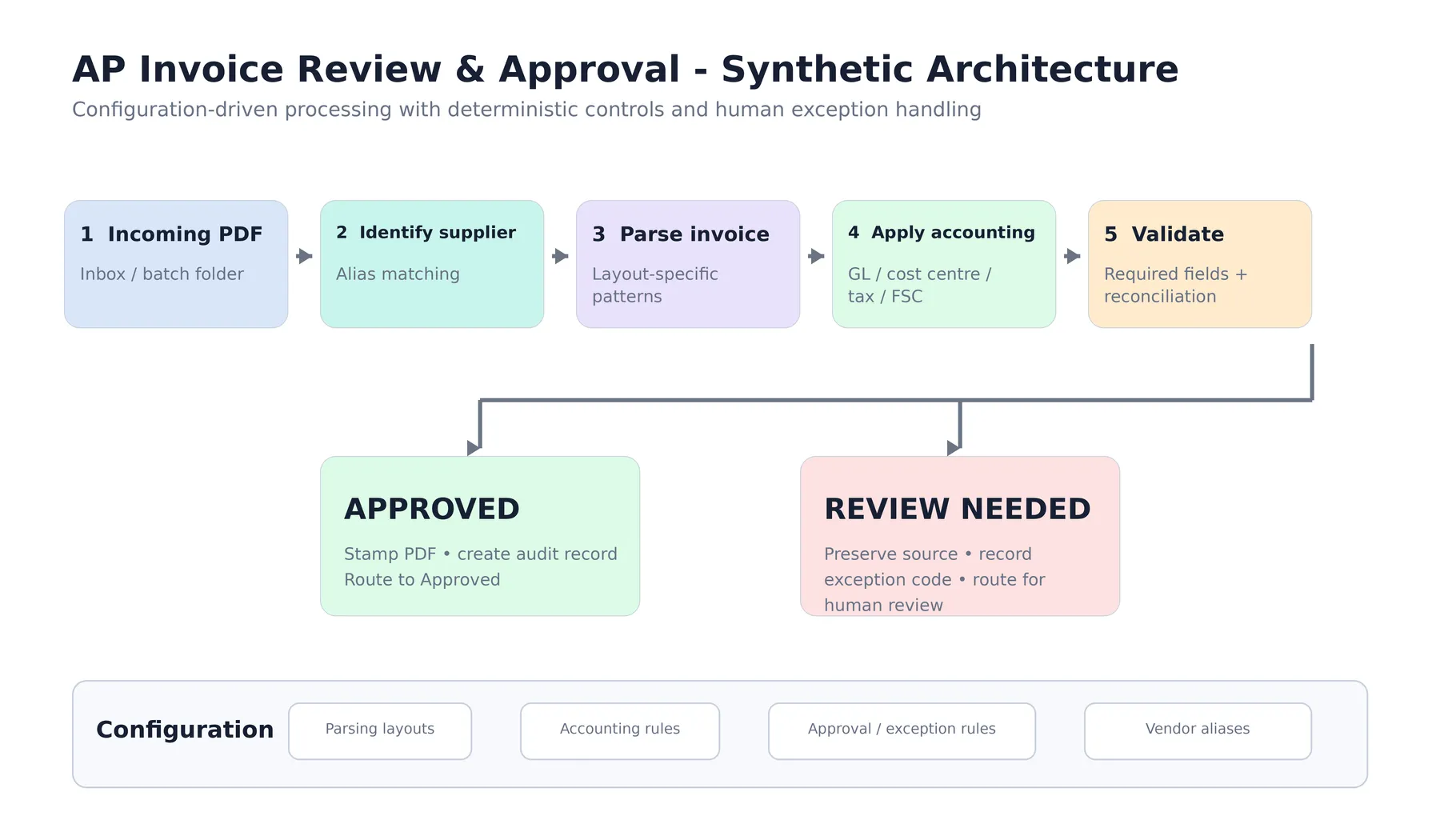
This separation matters because invoice layouts are less stable than the underlying business rules. When a supplier changes its document format, parsing can be adjusted without redesigning the accounting treatment or approval controls.
The solution
I developed a configurable Python workflow that processes incoming PDF invoices through a structured series of checks. The system:
- Identifies the supplier and applies supplier-specific document parsing rules.
- Extracts key invoice information and assigns accounting treatment.
- Validates totals, required fields, and approval parameters.
- Routes exceptions for human review.
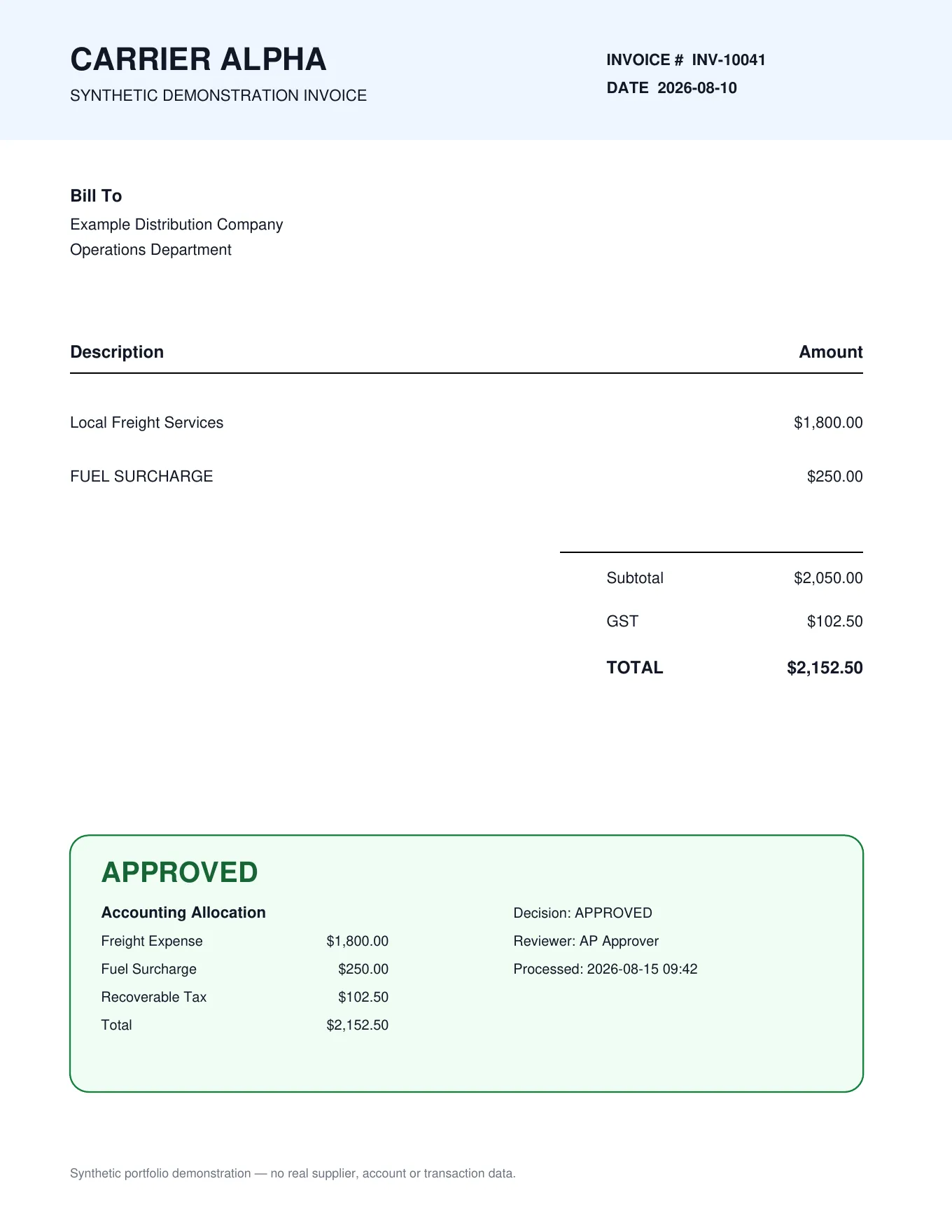
- Stamps successfully processed PDFs and creates a structured audit record.
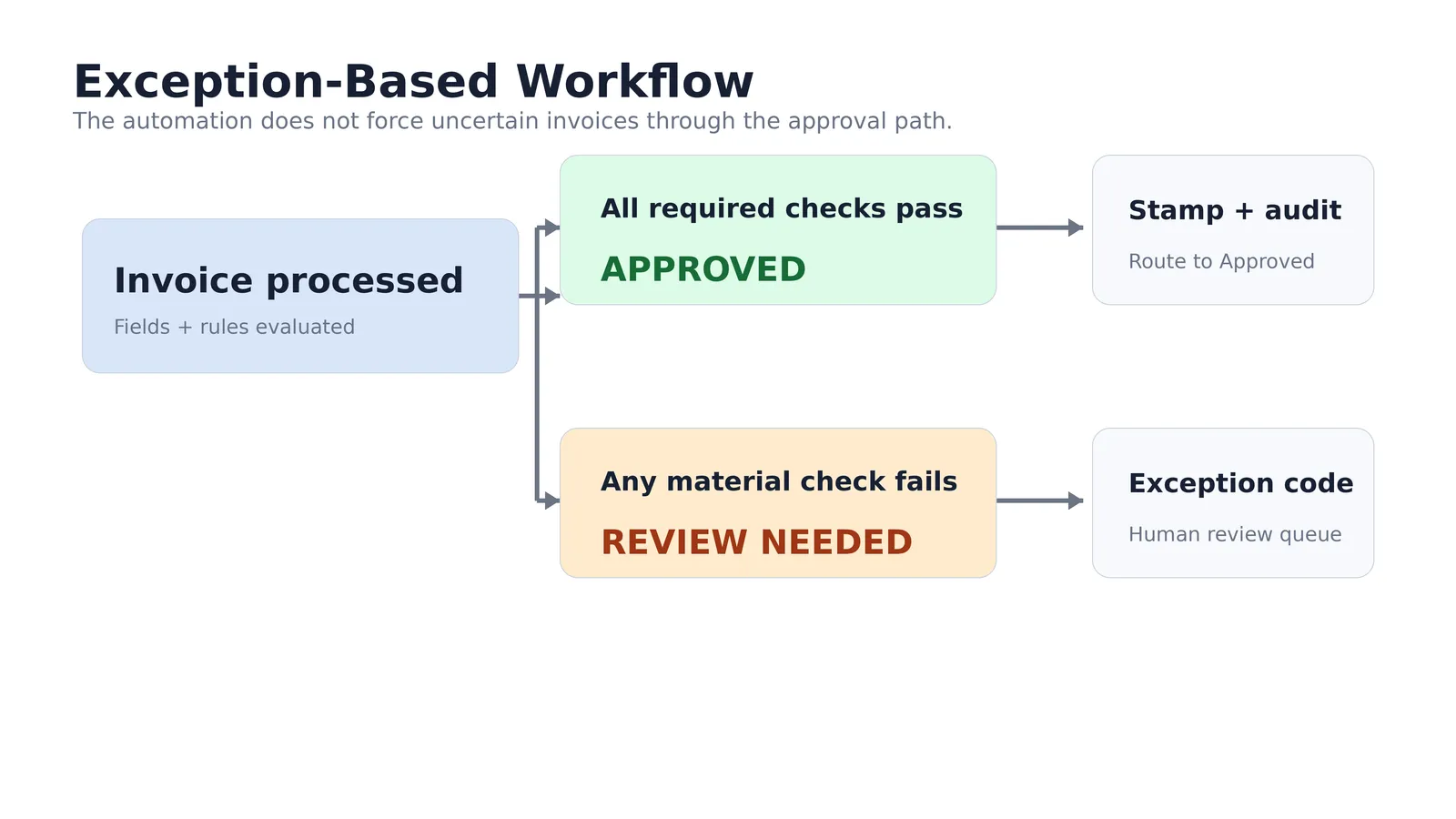
The workflow was deliberately designed around a fail-closed approach. If important information cannot be determined reliably, the invoice is not automatically approved. It is sent to a review queue with a clear reason.
Use human attention where it is valuable
The goal was not to eliminate human involvement. It was to use human attention where it was actually valuable.
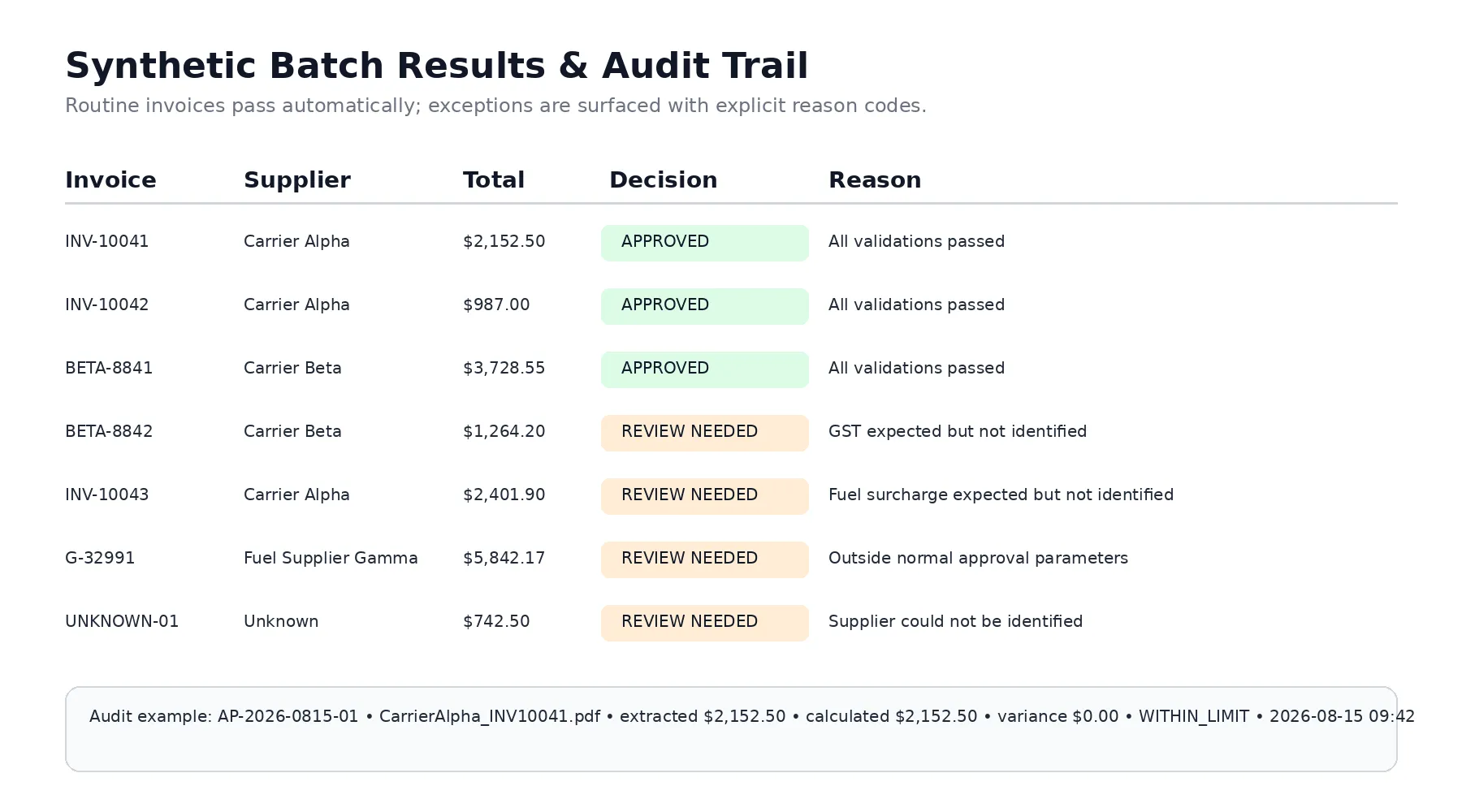
Routine invoices that satisfy all required checks can proceed through the normal workflow. Cases such as an unknown supplier, missing tax, an unexpected fuel surcharge, reconciliation problems, or amounts outside normal approval parameters are automatically surfaced for review.
When a material check fails, the source is preserved and a clear exception code carries the case into a human-review queue.
Controls and auditability
The workflow includes controls for required fields, supplier-specific treatment, accounting reconciliation, configurable tolerances, approval thresholds, explicit exception codes, preservation of source documents, human-review queues, and structured audit records.
Completed work and held exceptions appear in the same batch evidence, making each automated decision easier to trace without obscuring the cases that still require investigation.
Results
The process was redesigned from document-by-document manual review into an exception-based workflow.
Rather than treating every invoice equally, the system handles predictable cases consistently and directs human attention toward the transactions that actually require interpretation or investigation.